
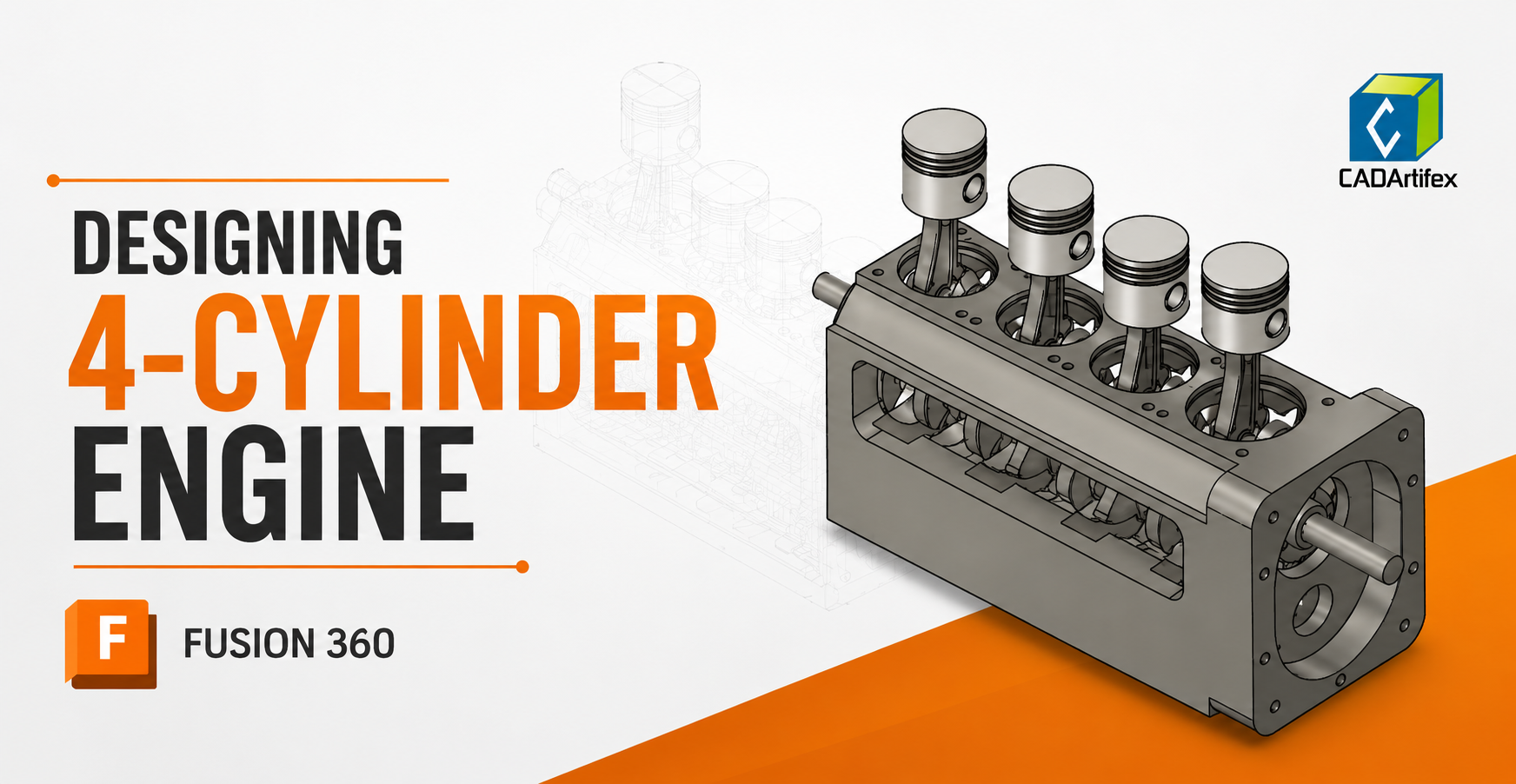
Learn how to design a realistic four-cylinder engine in Fusion 360. Explore parametric modeling, assemblies, motion-ready components, and real-world mechanical design techniques.
Designing an engine is one of the most rewarding projects for any mechanical engineering student or CAD professional. A four-cylinder engine combines nearly every important CAD concept—from parametric modeling and assemblies to motion-ready design and manufacturing considerations.
Whether you're learning Fusion 360 for academic projects, preparing for a design career, or building your engineering portfolio, creating an engine assembly helps develop practical skills that extend far beyond simple part modeling.
Why Engine Design Is an Excellent CAD Project
Unlike simple mechanical components, an engine consists of dozens of interconnected parts that must fit together precisely. A complete engine project teaches engineers how to:
- Build complex parametric models
- Design multiple interacting components
- Understand assembly relationships
- Maintain design intent
- Improve modeling efficiency
- Create manufacturing-ready parts
- Generate engineering drawings
This makes engine design one of the best real-world projects for improving CAD proficiency.
Major Components of a Four-Cylinder Engine
A typical four-cylinder engine includes several mechanical systems working together.
Engine Block
The engine block forms the foundation of the assembly. It houses cylinder bores, coolant passages, oil channels, mounting surfaces, and bearing supports. Designing the block requires careful attention to dimensions, wall thickness, and manufacturing constraints.
Pistons
Pistons convert combustion pressure into linear motion. During modeling, engineers focus on crown geometry, ring grooves, pin holes, weight optimization, and clearance with cylinder walls. Fusion 360's parametric tools make it easy to modify piston dimensions without rebuilding the model.
Connecting Rods
Connecting rods transfer force from the piston to the crankshaft. Important design considerations include the big-end bearing housing, small-end pin hole, beam profile, fillets for stress reduction, and strength-to-weight ratio.
Crankshaft
The crankshaft converts reciprocating motion into rotational motion. Designing a crankshaft involves main journals, crank pins, counterweights, oil passages, and accurate angular positioning. This is one of the most challenging components in engine modeling.
Cylinder Head
The cylinder head contains combustion chambers, intake ports, exhaust ports, valve seats, and spark plug locations. Complex surfaces make this component ideal for practicing advanced Fusion 360 modeling techniques.
Flywheel
The flywheel stores rotational energy and smooths engine operation. CAD modeling includes mounting holes, weight reduction pockets, center bore, and the ring gear profile.
Using Parametric Design in Fusion 360
One of Fusion 360's biggest strengths is parametric modeling. Instead of creating fixed geometry, dimensions are controlled using parameters. Benefits include:
- Faster design changes
- Automatic updates across assemblies
- Better design consistency
- Easy optimization
- Reduced modeling errors
For engine projects with many repeating components, parametric design saves significant time.
Assembly Design Techniques
After modeling individual components, they are assembled using joints and constraints. A complete engine assembly requires proper component hierarchy, revolute joints, rigid joints, motion relationships, and interference checking. Fusion 360 makes it possible to visualize how all parts fit together before manufacturing.
Motion and Mechanism Validation
Although this project focuses primarily on CAD modeling, properly assembled components can later be used for motion studies. This helps engineers verify crankshaft rotation, check piston movement, validate clearances, detect interference, and improve assembly quality. Motion-ready assemblies are an important skill in mechanical product development.
Engineering Skills Developed Through Engine Design
Completing a four-cylinder engine project improves several industry-relevant skills:
- Parametric CAD Modeling
- Mechanical Assembly Design
- Feature-Based Modeling
- Design Intent
- Manufacturing Awareness
- Mechanical Visualization
- Technical Drawing Creation
- Portfolio Development
These skills are highly valued in automotive, industrial equipment, and product design industries.
Common Challenges Beginners Face
New Fusion 360 users often struggle with managing large assemblies, creating complex sketches, maintaining design intent, organizing components, applying joints correctly, naming features properly, and avoiding broken references. Working through a structured project helps overcome these challenges much faster than practicing isolated exercises.
Learn to Design a Complete Four-Cylinder Engine in Fusion 360
If you'd like to build a realistic engine from scratch with expert guidance, the Designing Four Cylinder Engine in Fusion 360 Video Course by CADArtifex provides a complete project-based learning experience.
In this course, you'll learn how to design a complete four-cylinder engine step by step, create individual mechanical components with precision, assemble all parts into a functional engine model, apply professional Fusion 360 workflows, improve parametric modeling skills, and build a real-world engineering project for your portfolio.
Enroll NowFinal Thoughts
Designing a four-cylinder engine is much more than a CAD exercise—it's an opportunity to develop the practical engineering skills used in real product development. By modeling each component, assembling them accurately, and understanding how they interact, you'll gain valuable experience in parametric design, mechanical assemblies, and professional CAD workflows.
If you're ready to move beyond basic tutorials and tackle a comprehensive engineering project, a structured engine design course can accelerate your learning and help you build a portfolio that showcases real-world CAD expertise.
 - 3551-360x220.png)
 - 2085-360x220.png)
 - 3168-360x220.png)
